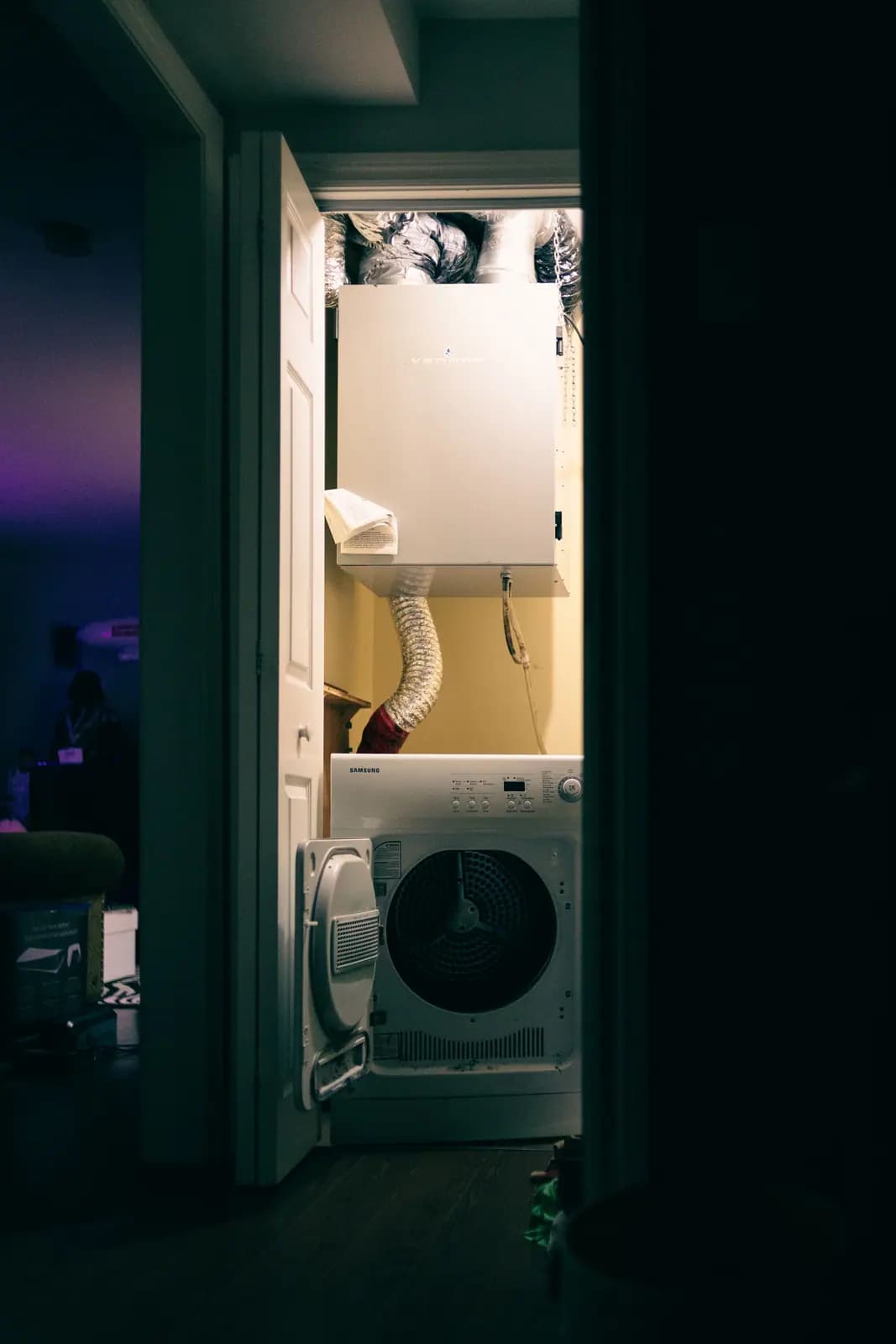
This page covers what's specific to Miami. For the full checklist — causes, safe checks, and repair or replace — see dryer repair.
Miami at a glance
- Housing pattern
- Many condos and high-rise apartments alongside single-family homes
- Before the visit
- Building approval, certificate of insurance, elevator booking
- Tap water
- Biscayne Aquifer, lime-softened by Miami-Dade Water and Sewer — still mineral-rich
Unit or building? Find the restriction
| Test | Result | Points to |
|---|---|---|
| Run the dryer with the lint screen clean and feel airflow at the duct connection behind it | Strong airflow at the dryer outlet | The restriction is downstream — duct or shared exhaust |
| Same test | Weak airflow at the dryer outlet itself | Lint inside the dryer cabinet or a failing blower — technician |
| Ask management when the exhaust risers were last cleaned | Not in recent memory | Request building exhaust service |
| Clothes damp, cabinet cool, airflow strong | — | Heating element, thermal fuse or gas ignition — technician |
Why shared exhaust behaves differently
A house dryer pushes air a short distance to an outside wall. In many towers, each unit's dryer feeds a vertical riser shared with the floors above and below; some buildings rely on a booster fan to keep that riser moving. When the riser loads with lint or the fan stops, every dryer on the stack slows down at once — so ask neighbours on your stack whether their drying times changed too.
Because lint is a leading factor in dryer fires, a restricted shared exhaust is a building safety issue, not just an inconvenience. Report it to management in writing.
What you can safely do
- Clean the lint screen every load and wash it if it's coated with dryer-sheet residue.
- Replace crushed or foil-type transition duct behind the dryer with semi-rigid metal duct, keeping it as short as the space allows.
- Don't push the dryer tight against the wall — leave room so the duct doesn't kink.
- Never open the building's riser or access panels; that's for the building's vendor.
Stop using the dryer if
Leave this to a professional
- You smell burning or see scorch marks.
- The cabinet is too hot to touch.
- It's a gas dryer and you smell gas — leave and call 911 from outside.
Booking the visit
Tell the provider it's a condo with shared exhaust, which floor you're on, whether a certificate of insurance is required, and when the service elevator is available. Stackable washer-dryer units in closets often need both machines pulled out — mention that too, because it affects time and price.
How a repair request works
- 1Call usTell us the appliance, the brand and what it's doing.
- 2Describe the problemBrand, model, symptoms, and what you've already checked.
- 3Provider reviews itThey contact you to accept and to ask anything they need.
- 4Diagnosis and quoteThe provider confirms any diagnostic fee and the repair price before work starts.
Common questions
My dryer got slow at the same time as my neighbour's. Is my dryer broken?
Probably not. A shared riser or a failed roof booster fan slows every dryer on the stack. Report it to building management before paying for a dryer repair.
Can I clean the shared dryer exhaust myself?
No. Risers and booster fans are building equipment; cleaning them requires access to other units or the roof. Clean your own lint screen and transition duct, and ask management to schedule the rest.